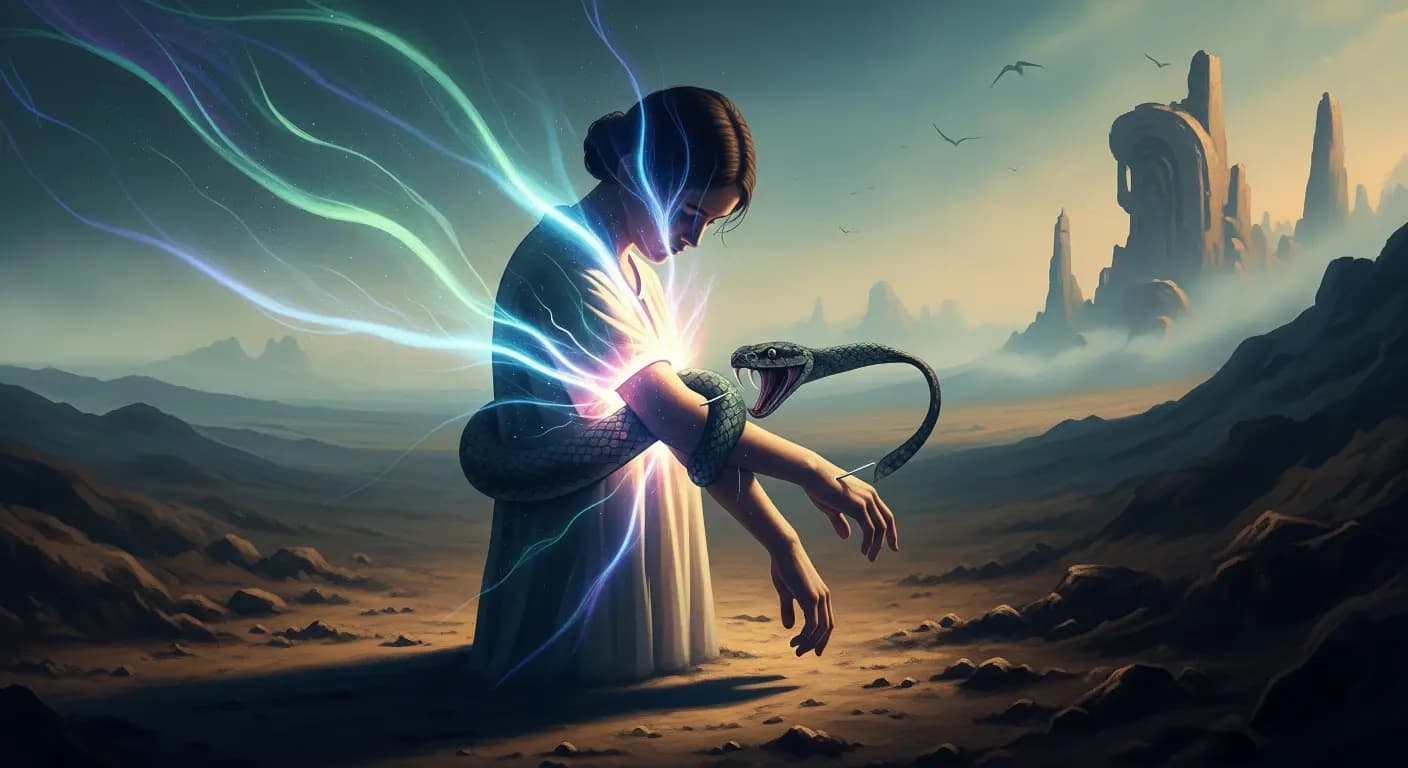
You are running, and something is behind you. It may be a person, an animal, a shadow, or a force you cannot name — but the terror is the same. Your legs feel heavy. The distance between you and whatever pursues you keeps closing. You push harder, and still the pursuer is there. Then you wake up, heart pounding, the fear refusing to leave even as the dream fades.
Dreams of being chased are reported across cultures, ages, and backgrounds with remarkable consistency. They rank among the most common dream experiences humans have, and they are almost universally described as distressing. But beyond the visceral fear, what do they actually mean? In Islamic tradition, which takes dream interpretation seriously as a discipline rooted in prophetic guidance, being chased carries specific and textured symbolism. And in psychology, the chase dream has been studied extensively as a window into the mechanisms of anxiety and avoidance.
Both frameworks arrive at a point of agreement: what is chasing you in a dream is rarely what it appears to be. The real question is not what is behind you, but what you have been unwilling to face.
What the Islamic Tradition Says About Being Chased
The Prophet Muhammad, peace be upon him, taught that dreams fall into three categories: true visions (ru'ya) from Allah, disturbing dreams from Shaytan, and dreams generated by the dreamer's own thoughts and concerns. Chase dreams most often belong to the third category — though the classical scholars were careful not to reduce all such dreams to mere psychological noise. The context, the pursuer, and the outcome all matter.
Muhammad ibn Sirin (654–728 CE), the foundational figure of Islamic dream interpretation, understood being chased in a dream as the experience of being pursued — by an enemy, a fear, or a problem that has not been resolved. The nature of the pursuit tells much of the story.
When you are chased by a known person, the interpretation points directly to that relationship: there is unresolved conflict, tension, or some matter outstanding between you and that individual. The dream is not predicting harm but surfacing an existing reality.
When you are chased by an unknown person, the symbolism shifts toward unidentified fears — concerns the dreamer has not yet given a name or a face, pressures that are felt but not yet understood.
When you are chased by a snake, the classical interpretation is that an enemy is pursuing you. The snake in Islamic dream tradition is among the most established symbols of an adversary or hidden threat.
When you are chased by a lion, the pursuer represents a ruler, a person of authority, or someone powerful who poses a threat. The lion is the symbol of royalty and power in classical Islamic imagery, and being pursued by one suggests a conflict with someone who holds significant influence over the dreamer's circumstances.
When you are chased by a dog, interpretations vary but often point to a persistent, aggressive adversary — someone who will not let a matter rest.
Being able to escape is the most encouraging element a chase dream can contain. In the classical tradition, escaping your pursuer means you will overcome your difficulties. The enemy, fear, or problem will not prevail. The escape is a sign of coming relief.
Being caught, conversely, suggests that the dreamer may face hardship — that the thing being avoided will, for a time, catch up. This is not necessarily a permanent defeat; even capture in a dream is read as a transitory difficulty rather than a final outcome. But it does suggest that attempting to outrun the issue will not work indefinitely.
Abd al-Ghani al-Nabulsi (1641–1731 CE) emphasized a principle that is central to understanding chase dreams: the identity and nature of the pursuer must be interpreted in light of that pursuer's own symbolic meaning. You cannot interpret the chase without understanding what the chasing entity represents. An unknown pursuer has one meaning; a known enemy has another; an animal carries the specific symbolism of that species. Each pursuer is a code that must be read before the dream can be fully understood.
The Pursuer as Symbol
The classical tradition's attention to the pursuer's identity is one of its most practically useful insights. Rather than treating being chased as a single undifferentiated symbol, it asks: who or what is chasing you, and what does that entity represent?
A known person chasing you: Some matter between you and that person is unresolved. This may be a conflict, a debt, an unexpressed grievance, or simply a relationship that carries unprocessed tension.
An anonymous human figure: An unidentified fear or generalized anxiety that has not yet taken on a specific shape in your waking life. The pursuer is unknown because you have not yet named what is troubling you.
A snake: A hidden enemy or someone who poses a covert threat. Snake symbolism in Islamic tradition is among the most consistent: the snake is an adversary.
A lion: A figure of authority — a ruler, a boss, a powerful person — who represents a source of pressure or threat in the dreamer's life. Being chased by a lion is a serious image, calling for caution in dealings with those who hold power over you.
A bull or powerful animal: Force and circumstance beyond one's control — perhaps natural forces or large-scale events that the dreamer feels unable to redirect.
An animal in general: Whatever that animal symbolizes in Islamic tradition, being chased by it suggests that symbolic threat is active in your life. Animals in dreams are rarely simply animals; they carry their inherited meanings.
A dark, shapeless presence: This is the most psychologically charged variant — an unnamed, unformed pursuer that exists only as dread. This type of dream is most closely associated with deep anxiety, suppressed emotion, or fears the dreamer has not been able to articulate even to themselves.
Escaping, Hiding, Being Caught
How the chase resolves carries as much interpretive weight as the chase itself.
Outrunning and escaping the pursuer is the most auspicious ending. You will overcome whatever is pursuing you — the enemy, the fear, the problem. The dream's resolution mirrors a coming resolution in waking life.
Hiding successfully is somewhat ambiguous. You are not yet confronting the issue, but you are avoiding it effectively for now. This can indicate a period of reprieve before the matter must be faced.
Being unable to move — one of the most distressing dream experiences, when your legs simply will not carry you fast enough no matter how hard you try — reflects a felt inability to escape a situation. The effort is there; the result is not. This is closely associated with feeling trapped or helpless in a waking circumstance.
Being caught signals that avoidance will not work. The matter will catch up with you. In the classical tradition, this is a warning rather than a condemnation — it calls the dreamer to stop running and begin addressing whatever is being pursued.
Turning to face the pursuer — which sometimes happens in chase dreams, though less commonly — is seen as the most resolute response. Confronting rather than fleeing is associated with courage, readiness, and the beginning of genuine resolution.
The Psychological Perspective
Psychology's approach to chase dreams is complementary to the Islamic tradition in an interesting way: both locate the source of the dream not in the external world but in the dreamer's own inner state.
For psychologists, the critical question in a chase dream is not "who is chasing me?" but "what am I refusing to confront?" The pursuer — whatever form it takes — represents something the dreamer is avoiding in waking life: a difficult conversation, a decision that keeps being deferred, a feeling that has been suppressed, a problem that has been acknowledged but not addressed.
The fight-or-flight response — the same biological mechanism that fires when a person is genuinely threatened — activates during chase dreams. The body experiences real physiological stress: elevated heart rate, heightened alertness, muscle tension. This is why waking from a chase dream can feel so exhausting. The body has genuinely worked during the night.
Stress and anxiety are the most reliable psychological triggers for chase dreams. Research consistently finds that these dreams increase in frequency during periods of heightened pressure — before major deadlines, during relationship crises, in the midst of significant life changes. The mind, unable to fully process its anxiety during the day, enacts it at night in dramatic physical form.
Avoidance patterns are also strongly linked to chase dreams. People who habitually defer difficult conversations, suppress uncomfortable emotions, or systematically avoid addressing problems report more frequent chase dreams. The avoided thing becomes, in the dream, something that pursues.
Unresolved conflict — with another person, with one's own values, or with circumstances that feel inescapable — is another consistent trigger. The conflict takes physical form in the dream, and the dreamer's attempts to escape it mirror their waking attempts to avoid resolution.
Why Chase Dreams Are So Physically Intense
Chase dreams are unusual among dream experiences in their physiological intensity. The body is not merely witnessing events; it is participating in them. Muscles can tense. The sleeper may move or vocalize. The emotional residue of the dream — the fear, the sense of danger — can persist for hours after waking.
This is because the dreaming brain engages with chase scenarios using the same neural pathways that process real threat. The amygdala — the brain's threat-detection center — cannot fully distinguish between an imagined pursuer and a real one. The danger feels real because, neurologically, it is being processed as real.
This is also why the content of chase dreams can feel so personally significant, even when intellectually one knows it was "just a dream." The body's response is the clearest evidence that the dream touched something genuine.
What to Do With a Chase Dream
From an Islamic perspective, a disturbing dream that feels threatening can be countered by seeking refuge from Shaytan upon waking, changing sleeping positions, and not narrating the dream to others if it was distressing. A dream arising from one's own fears is best addressed by addressing those fears in waking life.
From a psychological perspective, the most productive response to a recurring chase dream is to ask seriously: what am I avoiding? What in my waking life corresponds to the feeling of being pursued? What would it mean to stop running and turn around?
Keeping a dream journal and noting patterns — who or what is chasing, whether you escape, how you feel upon waking — can reveal a great deal over time. If the same pursuer appears repeatedly, or if chase dreams increase during particular periods of your life, the correlation with your waking circumstances is almost always clear in retrospect.
Frequently Asked Questions
Why do I keep getting chased in dreams? Recurring chase dreams are almost always tied to an ongoing source of stress, unresolved conflict, or something the dreamer has been systematically avoiding in waking life. The dream repeats because the underlying issue has not been addressed. The pursuer — whatever form it takes — will keep appearing until what it represents is faced rather than fled.
What does it mean to be chased by a person in a dream? If the person is known to you, the Islamic tradition interprets this as unresolved conflict or tension in that relationship — something between you and that person that has not been settled. If the person is unknown, it points to unidentified fears or pressures that have not yet taken on a specific name in your waking life.
Is being chased in a dream bad in Islam? Not necessarily. The dream's meaning depends heavily on what happens: if you escape, it is interpreted as a sign that you will overcome your difficulties. If you are caught, it suggests a coming hardship rather than a permanent defeat. The classical tradition treats chase dreams as meaningful communications — warnings or reflections to be taken seriously — rather than as uniformly negative omens.
What does it mean if you escape from the chaser? Escaping is the most positive resolution a chase dream can have. In the classical Islamic interpretation associated with Ibn Sirin's school, escaping your pursuer indicates that you will overcome the enemy, fear, or problem that the pursuer represents. The escape in the dream mirrors a coming victory in waking life.
What does it mean to dream of being chased by an animal? The animal's own symbolic meaning shapes the interpretation. A snake pursuer represents an enemy. A lion pursuer represents a figure of authority or power. A dog pursuer often indicates a persistent, aggressive adversary. Knowing the symbolism of the specific animal gives the most accurate reading of the dream.
Can chase dreams be positive? They can carry positive implications, particularly if you escape. Even the presence of a chase dream, while unpleasant, can be seen as the mind's way of processing and confronting anxiety — doing emotional work that ultimately leads toward resolution. The dream is disturbing precisely because it is taking something seriously that needs to be taken seriously.
You Might Also Like
- What Does It Mean to Dream About Falling? — Another high-intensity dream with deep interpretive roots
- Snake Dream Meaning — Islamic Interpretation — One of the most common dream pursuers explained fully
- Snake Bite in a Dream — When the threat catches up: the symbolism of being bitten
- Dreaming About Jinn or Spirits — When the pursuer is otherworldly
- What Does It Mean to See a Lion in Your Dream? — The lion as pursuer and the lion as symbol
- Recurring Dreams — Why They Keep Coming Back — When chase dreams repeat, they demand attention
- Being Late or Missing Something in Dreams — Another dream of urgency and anxiety
- People in Dreams Category — Browse all articles on people and figures in dreams