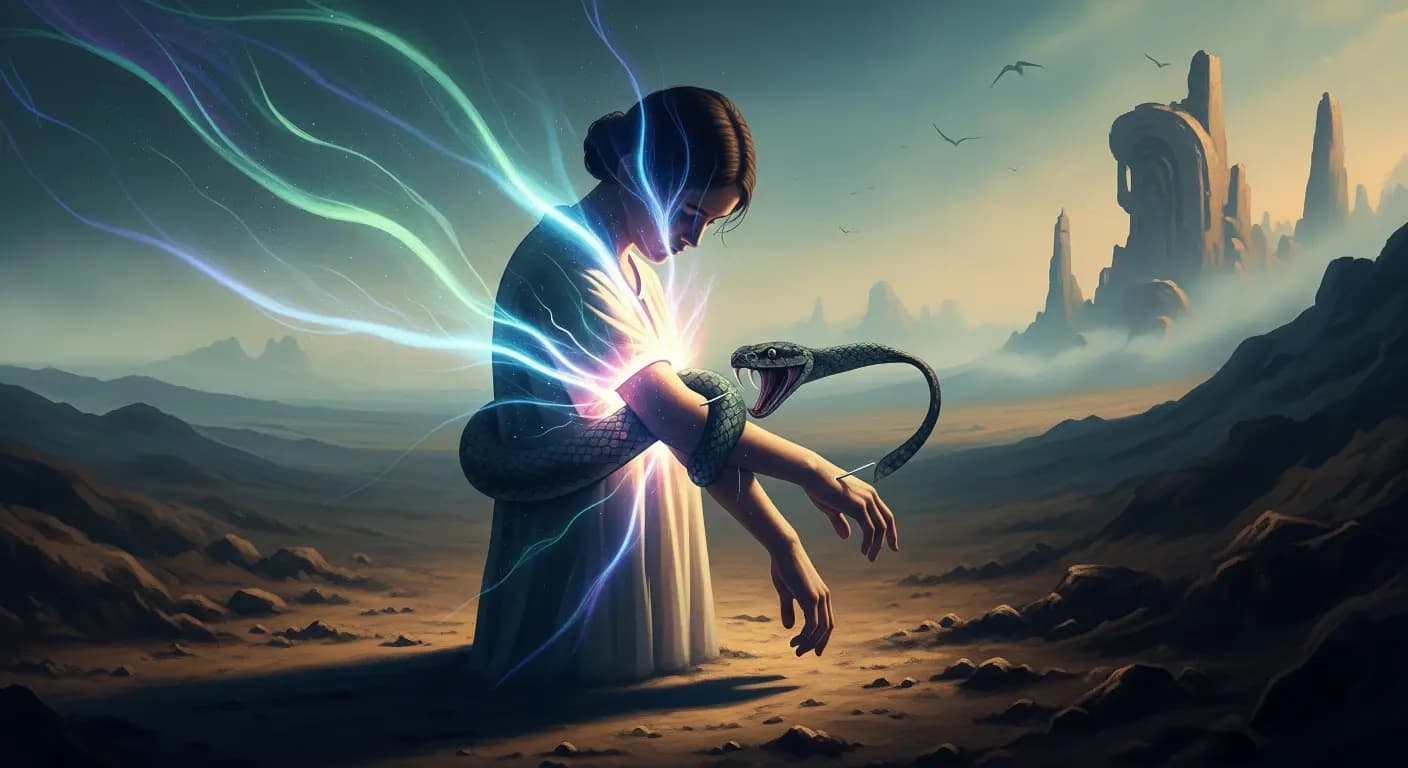
Few dream images provoke as strong a reaction as a snake. You wake up — heart hammering, the image still vivid — and immediately wonder whether it meant something. Across virtually every human civilization, the snake has carried weight as a symbol. It is feared and revered in equal measure. It destroys and heals. It deceives and reveals. Small wonder, then, that when a snake slithers into your dream, the encounter feels significant.
Whether you approach this from an Islamic standpoint, a psychological one, or simply a desire to understand yourself better, the snake dream rewards careful reflection. The meaning is rarely one-dimensional. It depends on the snake's behavior, its color, whether it attacked you, whether you fought back — and on your own circumstances at the time of the dream. This guide will walk through the major interpretive traditions, help you identify which scenario matches your dream, and offer practical spiritual guidance once you have a clearer picture.
What Does a Snake Mean in a Dream? Islamic Overview
In the Islamic tradition, dreams are taken seriously as a source of insight and, at times, divine communication. The Prophet Muhammad (peace be upon him) taught that true visions — called ru'ya — come from Allah, while disturbing dreams may come from Shaytan, and some dreams simply reflect what occupies the mind during waking hours. This hadith, recorded in both Sahih Bukhari and Sahih Muslim, forms the foundation of Islamic dream interpretation.
The science of interpreting dreams, known as ilm al-ta'bir, has a long history in Islamic scholarship. Surah Yusuf (Chapter 12 of the Quran) is dedicated almost entirely to the story of the Prophet Yusuf (Joseph), whose God-given ability to interpret dreams shaped the course of an entire civilization. This chapter established that dream interpretation is a divinely sanctioned field of knowledge, not superstition.
Within this tradition, the snake carries a largely negative primary meaning. It is most consistently interpreted as representing an enemy — hidden, dangerous, and deceptive. The snake's nature in Islamic symbolism reflects its behavior: it moves silently, strikes without warning, and its venom can be lethal. These qualities map onto the qualities of a hidden adversary, someone who harbors ill will, jealousy, or malice toward the dreamer. The snake in a dream can also represent Shaytan himself, who took the form of a serpent in the story of Adam and Eve — and this association deepens its spiritual significance.
That said, Islamic interpreters have always recognized that context transforms meaning. A snake that does not threaten you, or one you successfully overcome, carries a very different message than one that chases or bites you. The dreamer's circumstances — their relationships, their challenges, their spiritual state — must all be taken into account.
Ibn Sirin's Interpretation of Snake Dreams
Muhammad ibn Sirin (654–728 CE) is the most celebrated name in classical Islamic dream interpretation. His approach to snake dreams is among his most documented and widely cited, because the snake appears so frequently in the dreams people brought to him for interpretation.
The core principle in Ibn Sirin's school is straightforward: a snake in a dream represents an enemy. This enemy is typically characterized by deception and concealment rather than open conflict — which is precisely why the snake is the chosen symbol. An enemy who smiles at you while plotting against you in secret is far more dangerous than one who confronts you openly.
The behavior of the snake in the dream matters enormously. If the snake is simply present and non-threatening, it may indicate that an enemy exists in the dreamer's life without yet having caused harm. If the snake is aggressive, chasing or striking, the enemy may be actively working against the dreamer. If the dreamer kills the snake, this is generally interpreted as defeating that enemy — a victory, achieved perhaps through wisdom, caution, or Allah's grace.
The size of the snake is also meaningful in this tradition. A large, imposing snake may represent a powerful enemy — someone with influence, resources, or authority. A small snake might represent a lesser threat: someone who harbors grudges but lacks the means to act significantly on them.
The snake's location in the dream adds another dimension. A snake in your home may represent an enemy within your closest circle — family, close friends, or household. A snake in a marketplace or public space might indicate an enemy in your professional or social life.
Al-Nabulsi on Snake Dreams
Abd al-Ghani al-Nabulsi (1641–1731 CE), author of the encyclopedic Ta'tir al-Anam fi Tabir al-Manam, approached snake dreams with notable depth and nuance. While he largely agreed with the foundational interpretation — snakes as enemies — al-Nabulsi placed significant weight on the details of the vision to refine that meaning.
Al-Nabulsi paid particular attention to color as a modifier of the snake's meaning. A black snake, in his view, might indicate a powerful and formidable enemy. A green snake could point to someone whose enmity is less overt, or to jealousy rooted in envy of the dreamer's spiritual standing. Yellow and golden snakes carried associations with illness or wealth-related conflict. White snakes were sometimes linked to deception wrapped in apparent goodness — the enemy who appears pure or trustworthy.
Al-Nabulsi also considered whether the snake spoke in the dream, which he interpreted as a sign that the adversary might be someone who uses words as their weapon — gossip, slander, false testimony. A speaking snake in a dream was treated as a particularly serious warning to guard one's reputation and relationships.
His broader contribution was to emphasize that the same symbol could carry different meanings depending on the dreamer's personal context — their spiritual state, their relationships, and the emotional tone of the dream itself.
Snake Dream Meaning by Personal Situation
For a Man
When a man dreams of a snake, the traditional Islamic interpretation points toward an external threat — a business rival, a jealous colleague, a person who secretly wishes him harm. If the snake is aggressive, the dreamer may be facing an active challenge to his livelihood, reputation, or relationships. If the dreamer successfully confronts or kills the snake, it suggests he has the capacity — or will find the means — to overcome this threat. Men who dream of snakes during periods of professional conflict or difficult negotiations should pay extra attention to who around them may not have their best interests at heart.
For a Woman
For a woman, a snake dream can carry the enemy interpretation as well, but classical interpreters also associated it with a treacherous person in her intimate circle — sometimes a jealous rival, sometimes a person who appears friendly but harbors envy. In some interpretations, a snake dream for a married woman may relate to fears about her household security or her husband's loyalty. Context and emotional tone matter greatly here. If the dream felt threatening and she could not escape, the concern may be more pressing than if the snake was simply observed from a distance.
For a Single Person
For someone who is unmarried, a snake dream may reflect anxieties about trust and relationships in general. The dream could be flagging someone in the social or romantic sphere who is not what they appear to be. It may also reflect inner fears about vulnerability — the discomfort of not yet having found a stable, trustworthy partnership. Paying attention to who comes to mind immediately upon waking can sometimes offer a clue about the dream's intended subject.
For a Married Person
Within a marriage, a snake dream sometimes surfaces when trust has been strained — real or imagined. It may reflect a fear of betrayal, or the sense that something important is being concealed. Alternatively, it may point to a third party outside the marriage who is causing disruption. If the dreamer is in a secure and happy marriage with no obvious concerns, the dream may relate to a threat in another area of life entirely — work, family, finances.
For a Pregnant Woman
Islamic interpreters traditionally view snake dreams for pregnant women through a more cautious lens. A snake encountered without harm may simply reflect the heightened anxieties of pregnancy — the feeling of vulnerability and the instinct to protect. However, if the snake is aggressive or causes harm in the dream, it might be worth examining what sources of stress surround the pregnancy. Some classical interpretations associate the snake in this context with concerns about the child's wellbeing, though this should not cause alarm — dreams are not prophecies.
For a Divorced Person
Someone who has recently gone through a divorce and dreams of a snake may be processing residual hurt or betrayal. The snake, as an enemy figure, could represent the former partner, or it could represent the broader sense of having been deceived or wounded by someone once trusted. If the dreamer kills the snake in the dream, this is a positive sign — indicating that they are moving through grief toward resolution and strength.
Common Snake Dream Scenarios
A Snake Chasing You
Being pursued by a snake in a dream suggests you are aware of a threat — but are avoiding confronting it. The thing you are running from in waking life may be a conflict, a responsibility, or a person whose intentions make you uneasy. The dream is rarely a comfortable one, but it carries an important message: avoidance only prolongs the problem. In the Islamic interpretation, being chased by a snake means an enemy is actively pursuing you, and continued flight leaves you vulnerable.
Killing a Snake
This is one of the more positive snake dream scenarios. Killing a snake — particularly one that was threatening you — is widely interpreted as defeating an enemy or overcoming a significant obstacle. In Ibn Sirin's school, this outcome is reassuring: it suggests the dreamer has the spiritual strength, the resources, or divine protection necessary to overcome the adversary the snake represents. If the snake was killed easily, the threat may not be as serious as it seemed.
A Snake in Your Home
Finding a snake inside your house — especially in private rooms — is treated as a significant warning in classical Islamic interpretation. The home represents the self, the family, and the innermost circle of trust. A snake in this space suggests that the threat comes from someone close: within the household, within the family, or among intimate friends. This dream calls for careful reflection on close relationships and honest assessment of anyone who might be harboring hidden resentment.
Being Bitten by a Snake
A snake bite is one of the most vivid and emotionally intense snake dream scenarios. Classically, it indicates that an enemy has already caused harm — or is about to. The location of the bite offers additional clues. A bite to the hand may relate to livelihood or work. A bite to the foot may relate to one's path or direction in life. A bite to the head or face may indicate an attack on reputation or dignity. For a full exploration of snake bite dreams, see our dedicated article.
A Non-Threatening Snake
Not every snake dream is ominous. If the snake was simply present — watching, moving peacefully, or behaving neutrally — the dream may simply be drawing your attention to the existence of an adversary without urgency. It could also reflect the dreamer's own qualities: cunning, perceptiveness, or the ability to sense hidden dynamics. Some interpreters see a calm, non-threatening snake as a reminder to stay alert without being afraid.
The Psychological Perspective
Western psychology, particularly through the work of Carl Jung, offers a complementary lens for understanding snake dreams. Jung viewed the snake as one of the most powerful archetypes in the human unconscious — a symbol that appears across virtually all cultures because it taps into something deeply embedded in our psyche.
For Jung, a snake in a dream often represented the shadow — those aspects of the self that are repressed, feared, or unacknowledged. The shadow is not inherently evil; it contains creative energy, raw instinct, and authentic emotion that the conscious mind has suppressed in order to function socially. When the snake appears, the unconscious may be asking the dreamer to acknowledge something they have been avoiding within themselves.
The snake is also a classic symbol of transformation. A snake sheds its skin entirely, emerging renewed. This biological reality has made the snake a symbol of regeneration in traditions as diverse as ancient Egypt, Greek medicine (the Rod of Asclepius), and indigenous cultures worldwide. A snake dream may therefore signal an approaching period of significant change — painful, perhaps, but ultimately renewing.
Freud, characteristically, viewed snakes in terms of suppressed desires, particularly sexual energy that has been denied or repressed. While this interpretation has fallen somewhat out of fashion as the sole reading, it remains relevant when the dream has a distinctly sensual or physical quality.
Modern sleep researchers and therapists often approach snake dreams by asking what the dreamer was feeling during the encounter. Fear, fascination, calm, or disgust — each emotional response points in a different interpretive direction and reflects a different relationship with whatever the snake symbolizes in that person's inner life.
Spiritual Guidance After This Dream
If you have had a disturbing snake dream, the Islamic tradition offers clear and comforting guidance. The Prophet Muhammad (peace be upon him) advised that upon having a bad dream, one should seek refuge in Allah from Shaytan by saying A'udhu billahi min ash-Shaytan ir-rajim, turn to one's other side, and not share the dream with others. This prevents the dream from gaining unnecessary weight in the mind and in social dynamics.
You are also encouraged not to interpret a disturbing dream yourself in the immediate aftermath of waking, when emotions are running high. Wait until you are calm, then reflect on what the dream might be pointing to in your waking life. If a particular person or situation comes to mind, take it as an invitation to be more cautious and discerning — not as a definitive prophecy.
Increasing prayers, seeking Allah's protection through regular recitation of Ayat al-Kursi before sleep, and maintaining the evening remembrances (adhkar al-masa') are all recommended practices for someone whose dreams have been troubling. These acts of worship create a spiritual shelter and bring peace of mind.
If the dream has made you curious about a particular relationship or situation, treat it as a prompt for honest self-reflection rather than a verdict. Dreams guide; they do not decide.
Conclusion
The snake dream is one of the most layered and meaningful experiences in the human dream world. From the perspective of Islamic classical scholarship, it most commonly represents a hidden enemy, a secret adversary, or someone whose jealousy or malice the dreamer has not yet fully recognized. The behavior of the snake, its color, its location, and the dreamer's own response all refine this core meaning.
From the perspective of modern psychology, the snake invites the dreamer to confront what has been suppressed — hidden fears, unexplored instincts, or changes that need to happen but have been resisted. The two frameworks are not as contradictory as they might initially appear: both suggest that the snake dream is asking you to pay attention, to look honestly at something you may have been avoiding.
Whether your snake dream felt threatening or simply curious, treat it as an opportunity — to reflect on your relationships, examine your inner life, and deepen your spiritual awareness. And if it was truly unsettling, take refuge in the divine protection available to you, trust in your own resilience, and rest knowing that awareness of a danger is already the first step toward overcoming it.
Frequently Asked Questions
Is seeing a snake in a dream good or bad in Islam? In Islamic dream interpretation, snakes are generally considered a warning symbol representing an enemy or hidden adversary. However, the full meaning depends on context — if you killed the snake or it did not threaten you, the dream may carry a more positive or neutral message.
What does it mean to kill a snake in a dream? Killing a snake in a dream is typically interpreted as a victory over an enemy. It suggests that the dreamer has the spiritual strength or divine support needed to overcome a threat or challenge in their waking life. This is considered one of the more positive snake dream outcomes.
What does a black snake mean in a dream? A black snake is generally associated with a powerful or particularly dangerous enemy. In the classical Islamic tradition, black often intensifies the warning — pointing toward someone with significant influence or the ability to cause serious harm.
What does it mean when a snake is chasing you in a dream? Being chased by a snake suggests you are aware of a threat but are avoiding confronting it. In the Islamic interpretation, an active pursuit by a snake indicates that an enemy is working against you and that passivity may leave you vulnerable.
What does a green snake mean in a dream? Interpretations of a green snake vary. Some classical scholars associate it with a lesser or more concealed threat — perhaps jealousy rooted in envy of one's spiritual or material standing. In psychological terms, green can represent growth and nature, making a green snake symbolize instinctual or natural forces rather than malicious intent.
Should I be worried if I dream about a snake? A snake dream is worth reflecting on but should not cause fear or alarm. The Islamic guidance is to seek refuge in Allah, avoid sharing disturbing dreams, and use the experience as an invitation to pay closer attention to your relationships and circumstances.