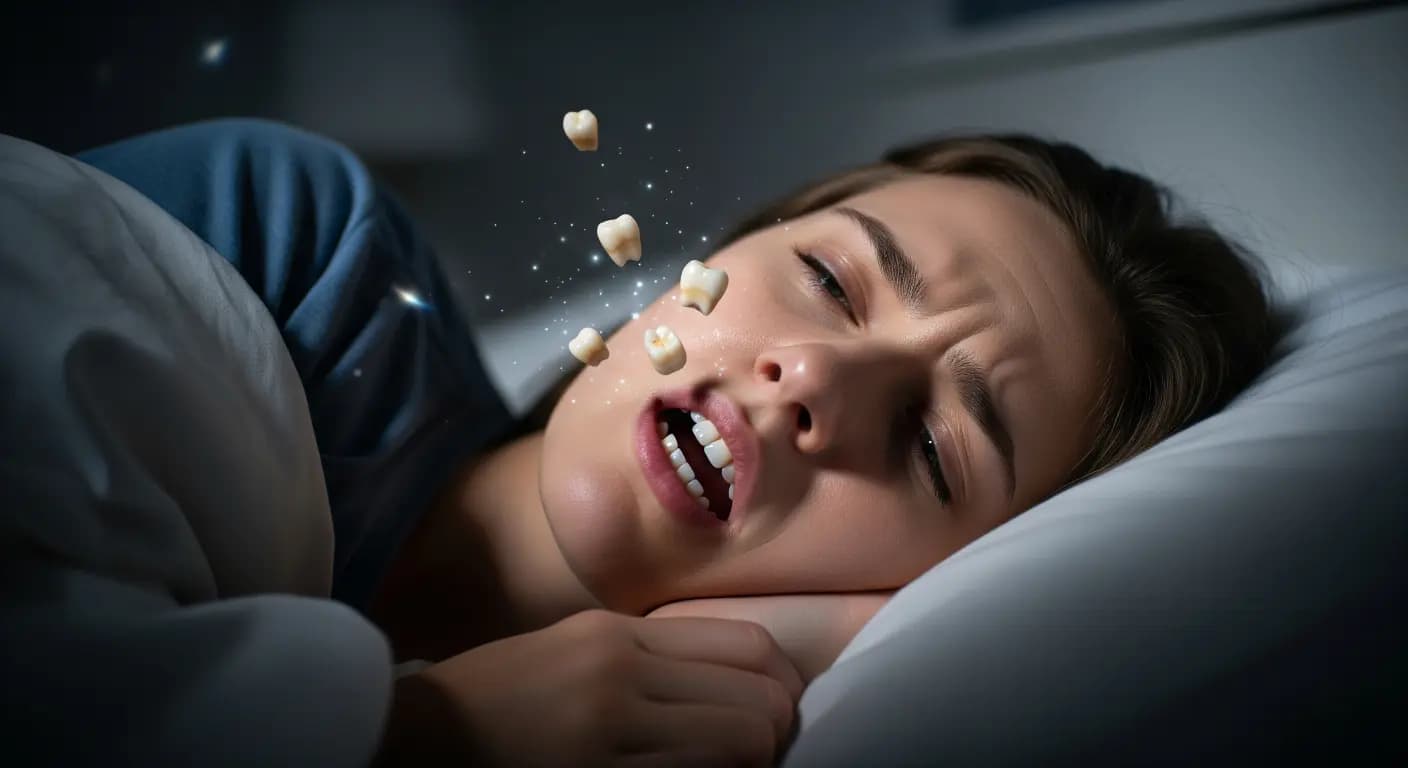
Few dreams are as unsettling as watching your own teeth fall out. You press your tongue to a tooth and it shifts. You open your mouth and they begin to drop — one, then another — crumbling or simply coming free with a sickening ease that no tooth should have. The dream can feel so real that the first thing many people do upon waking is press their fingers to their teeth to check that they are still there.
This is one of the most universal dream experiences in human culture. Researchers studying dreams across populations consistently find that teeth dreams appear in virtually every cultural tradition they examine. In the Islamic world, where dream interpretation has a long and scholarly lineage, the dream of losing teeth has been given one of the most specific and consistent interpretations in the entire canon. And in modern psychology, it remains one of the most frequently studied recurring dream types, with strong links to anxiety, major life transitions, and concerns about identity and control.
What makes this dream so persistent, and what does it actually mean?
The Islamic Interpretation: Teeth as Family
The classical Islamic interpretation of losing teeth in a dream is one of the most precise in the entire tradition — and it may surprise those expecting an interpretation about anxiety or self-image. In the framework established by Muhammad ibn Sirin (654–728 CE), teeth in a dream represent the dreamer's family.
This is not arbitrary symbolism. The teeth of the mouth are the members of the household in their arrangement and function: the front teeth, which are the most visible, correspond to the dreamer's children or immediate family — those who are closest and most prominently associated with the dreamer. The back teeth — the molars — correspond to more distant relatives, extended family members, or those who provide support and sustenance from the background.
With this foundation established, the loss of teeth in a dream becomes a map of family-related concerns:
A single tooth falling out indicates a loss involving one family member — not necessarily a death, but a loss of some kind: a departure, a separation, a rupture in the relationship, or some diminishment in the person's circumstances.
Losing a tooth without pain is interpreted as a minor loss — something passes or changes, but without great suffering. The painlessness in the dream mirrors a relative ease in the waking reality.
Losing a tooth with significant pain indicates a more serious loss — one that is felt deeply and that carries real grief or difficulty with it.
Teeth falling out while the dreamer collects them — reaching down to gather teeth from the ground or from one's hand — carries a specific interpretation: dispersal of the family. The gathering suggests an attempt to hold together what is scattering, to keep connected what is pulling apart.
All the teeth falling out at once suggests a widespread loss or disruption touching the whole family structure. This is among the more serious images in this category of dreams, though the tradition is careful not to reduce it to a single fixed meaning.
Abd al-Ghani al-Nabulsi (1641–1731 CE), in his comprehensive Ta'tir al-Anam, built on this family symbolism with additional distinctions. In his analysis, upper teeth correspond to male relatives — fathers, brothers, sons, uncles — while lower teeth correspond to female relatives — mothers, sisters, daughters, aunts. This allows a more specific interpretation: which jaw the teeth fall from points to which branch of the family is implicated.
Al-Nabulsi also noted that a tooth falling out and then regrowing is a particularly hopeful image. It suggests a matter that resolves itself — a loss that is temporary, a disruption that heals. The regrowth of the tooth in the dream mirrors a coming restoration in waking life.
Teeth crumbling rather than simply falling — disintegrating, breaking apart in fragments — he associated with weakness in one's affairs or health: a gradual erosion rather than a sudden loss, a wearing-down that happens slowly.
The Question of Age and Context
Classical interpreters also factored in the age and life circumstances of the dreamer, recognizing that the same image carries different weight in different lives.
For an elderly person, a dream of losing teeth may be understood in a more solemn light, potentially touching on concerns about one's own mortality or the mortality of those close in age. The classical interpreters were honest that for someone already in the later stages of life, certain tooth dreams could be read as omens of significant transition — though always within the understanding that death and its timing belong entirely to Allah.
For a young person, losing teeth is more commonly associated with family changes: a sibling leaving, a relative's circumstances shifting, a change in the household's composition or stability.
For a person experiencing significant life stress — financial pressure, relationship difficulties, health challenges — the teeth dream often surfaces as a representation of the felt vulnerability in the most basic foundations of life.
What the Symbolism Really Says
Understanding why the classical tradition chose teeth to represent family illuminates the interpretation more deeply. Teeth are fundamental. They are among the first features to develop and the last to be surrendered with age. They are necessary for sustenance — without them, one cannot eat. They are used for defense, for communication (the sound of speech requires them), and they are one of the most immediately visible features of the human face. They are both strong and surprisingly fragile.
Family, in the classical Islamic understanding, is similarly fundamental. The family is the unit through which provision flows, through which protection is organized, through which identity is grounded. A threat to one's teeth in a dream reflects, in this framework, a threat to one's most essential human connections.
The precision of the symbolism — front teeth for close family, back teeth for extended family, upper for male relatives, lower for female — suggests how carefully the classical scholars attended to the structure of both mouth and household.
The Psychological Perspective
Modern psychology offers a different but equally substantive framework for understanding teeth dreams. Where Islamic tradition sees family, psychology tends to see the self — specifically, one's felt sense of control, identity, and social standing.
Teeth are bound up with appearance and self-image. They are among the first things others notice. Dreams of losing them often arise when the dreamer is feeling exposed, judged, or concerned about how they are perceived. A public-facing challenge, a situation where one fears embarrassment, a period of vulnerability around status or appearance — these are common triggers.
Anxiety about control is another major psychological theme. Teeth are things we manage: we clean them, protect them, maintain them. Their loss in a dream represents something slipping from the dreamer's grasp — circumstances that were orderly and maintained becoming suddenly chaotic.
Communication difficulties surface in teeth dreams more often than one might expect. Teeth are necessary for speech; losing them in a dream can reflect a felt inability to express oneself effectively, to be heard, or to articulate something important. Dreamers who are suppressing something they need to say, or who fear that speaking up will cost them something, sometimes experience this theme in tooth-loss form.
Major life transitions are strongly correlated with teeth dreams in psychological research. Moving, beginning or ending a relationship, changing careers, becoming a parent, losing a parent — all of these transitions, which involve something ending so that something new can begin, appear with unusual frequency in the lives of people reporting teeth dreams.
And fears about aging or declining vitality — concerns about one's body, one's relevance, one's power — can also manifest through this image. Teeth are among the body's most visible markers of age and health. Their loss in a dream can express fears about time passing and what it takes away.
Why This Dream Is So Common
Dream researchers have proposed several explanations for the universality of the teeth dream. One is that physical sensations during sleep — jaw tension, bruxism (grinding), or dental discomfort — can be incorporated into dream content, producing a dream of teeth that reflects a genuine bodily experience.
Another explanation is cultural: once a person learns that others have teeth dreams, they may be more likely to notice and remember their own. The dream exists at the intersection of the personal and the collective — something genuinely individual (your family, your anxieties) expressed through an image widely recognized as meaningful.
A third explanation, compatible with both the Islamic and psychological frameworks, is simply that teeth represent something genuinely essential — whether family (in the Islamic reading) or self (in the psychological one) — and the sleeping mind returns to this essential symbol whenever something essential is threatened or in flux.
Responding to Teeth Dreams
Both frameworks suggest that the response to a teeth dream should be reflective rather than reactive. The dream is not a direct prediction; it is a signal. In Islamic understanding, the dreamer is invited to examine their family relationships: is someone in need? Is there a bond that has been neglected? Is there a matter of family concern that has been avoided?
From a psychological perspective, the questions are slightly different but adjacent: what am I most anxious about right now? Where do I feel most exposed or out of control? Is there something I have been unable or unwilling to say?
In both cases, the dream is most useful when treated not as an event to be frightened by but as information to be engaged with.
Frequently Asked Questions
What does losing teeth mean in Islamic dream interpretation? In the classical Islamic framework, teeth represent the dreamer's family members. Losing teeth in a dream is associated with loss or change involving family — whether through death, separation, departure, or some disruption in the family bond. Front teeth correspond to close immediate family; back teeth to extended relatives. Al-Nabulsi added that upper teeth represent male relatives and lower teeth represent female relatives.
Does losing a tooth in a dream mean someone will die? Not necessarily. While the classical tradition does connect tooth loss to loss involving family members, "loss" in this context encompasses many experiences — a departure, a separation, a significant change in someone's circumstances, as well as death. A tooth falling without pain suggests a minor or relatively easy loss; a tooth falling with significant pain suggests a more serious one. The dream is not a fixed prophecy.
What does it mean if all your teeth fall out in a dream? Losing all of one's teeth at once suggests a more widespread disruption touching the whole family structure, rather than a single person or relationship. Al-Nabulsi associated teeth crumbling and falling completely with a weakening of one's affairs more broadly. This is among the more serious tooth-loss dream scenarios, but it does not have a single, universally fixed interpretation.
Why is the losing teeth dream so common? Teeth dreams appear across virtually all cultures and populations studied by dream researchers. Several factors contribute: physical sensations during sleep (jaw tension, teeth grinding) can generate dream imagery; teeth are bound up with both appearance and essential function in ways that make them natural symbols for vulnerability; and the image carries both personal significance (family, in the Islamic reading; self-image, in the psychological one) and cultural familiarity, making it easy to notice and remember.
What does it mean if a tooth falls out and grows back in a dream? Al-Nabulsi interpreted a tooth that falls and then regrows as a matter that resolves itself — a loss that is temporary, a disruption that heals. This is one of the more hopeful tooth-related dream scenarios, suggesting that what is lost or disrupted will be restored.
Can teeth dreams be about health? In some cases, yes — physical causes such as teeth grinding during sleep, jaw tension, or actual dental discomfort can generate tooth-loss dream imagery. It is worth paying attention to whether the dreams coincide with physical symptoms. In the Islamic tradition, health concerns can also appear symbolically in dreams, though the primary symbolism of teeth remains familial.
You Might Also Like
- Recurring Dreams — Why Do They Keep Coming Back? — Teeth dreams that repeat carry amplified significance
- What Does It Mean to Dream About Falling? — Another anxiety-linked universal dream experience
- Being Chased in a Dream — The psychology and Islamic meaning of pursuit dreams
- Dead Relatives in Dreams — Why Do I See Them? — When family members appear in dream imagery
- Unknown People in Dreams — When the people in dreams are strangers
- Losing Money or Valuables in a Dream — The broader theme of loss in Islamic dream symbolism
- Pregnancy in Dreams — What Does It Mean? — Family and new beginnings in dream symbolism
- People in Dreams Category — Browse all articles on people and relationships in dreams