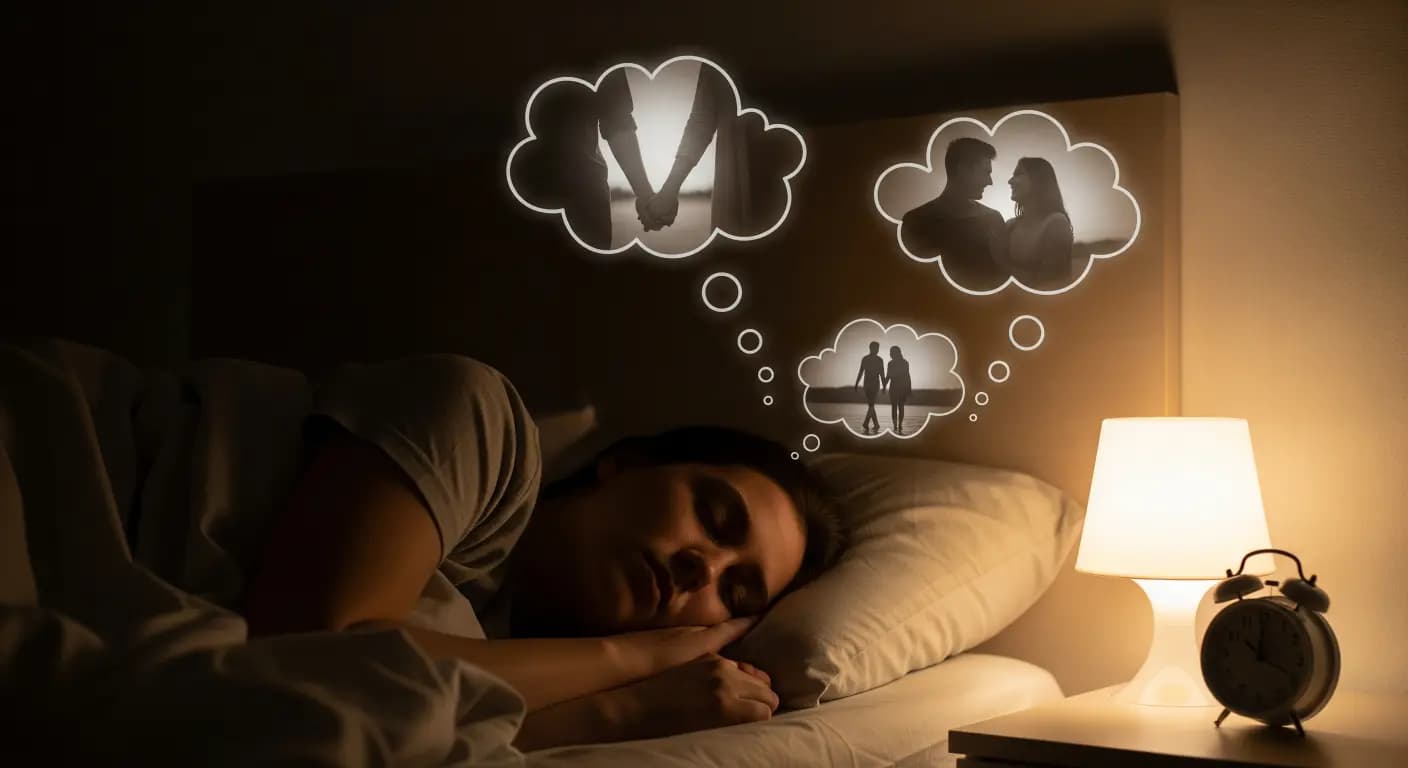
Few dreams carry as much emotional weight as dreams about marriage. You wake up from them feeling elated, confused, anxious, or profoundly moved — sometimes all at once. Whether you were the one getting married, a guest at someone else's wedding, or simply a bystander watching a ceremony unfold, the dream tends to stay with you through the morning.
In Islamic tradition, marriage is one of the most symbolically rich and carefully studied themes in the science of dream interpretation. Far from being a simple prediction of upcoming nuptials, a marriage dream — according to the classical scholars — carries layers of meaning related to authority, responsibility, spiritual status, and the soul's deepest aspirations. At the same time, modern psychology offers its own compelling perspective on why our sleeping minds so often stage elaborate ceremonies.
This article explores both dimensions thoroughly, drawing on authentic Islamic scholarly tradition and psychological research, to give you the most complete and useful guide to understanding marriage in dreams.
The Islamic Foundation: What Is a True Dream?
Before interpreting any specific dream, Islamic tradition asks us to first understand what kind of dream we are dealing with. The Prophet Muhammad (peace be upon him) taught, as recorded in both Sahih al-Bukhari and Sahih Muslim, that dreams come in three types: a good vision (ru'ya) from Allah, a disturbing dream from Shaytan, and a dream arising from the thoughts and concerns of a person's own mind (hadith al-nafs).
This framework matters enormously when interpreting marriage dreams. If you wake from a marriage dream feeling a sense of peace, calm, and spiritual elevation, it may belong to the first category — a true vision carrying genuine meaning. If the dream felt disturbing, strange, or left you spiritually unsettled, the classical scholars advise seeking refuge in Allah and not assigning it prophetic significance. And if you have been thinking intensely about marriage, relationships, or commitment in your waking life, the dream may simply be your mind processing those ongoing thoughts.
With this context in place, we can now examine what the scholars say about the specific symbol of marriage.
Ibn Sirin's Tradition on Marriage Dreams
Muhammad ibn Sirin (654–728 CE) is the most celebrated Islamic dream interpreter in history, and his work — transmitted through centuries of Islamic scholarship — treats marriage as one of the most multidimensional symbols a dreamer can encounter.
At the heart of Ibn Sirin's approach to marriage dreams is a crucial distinction: marriage in a dream does not simply mean marriage in waking life. Instead, it represents the taking on of something — a new status, a new responsibility, a new contract between the dreamer and the world.
When a man dreams of marrying a woman he knows, the scholars in Ibn Sirin's tradition interpret this as potentially acquiring something associated with her — her qualities, her family's standing, or something she represents in the dreamer's waking life. If the known woman is admired and respected, the dream may indicate honor, elevation, or a new position in one's community or profession.
When a man dreams of marrying a woman he does not recognize — a complete stranger — the interpretation shifts toward gaining a new status or office. The unknown woman represents an undefined future: something is coming that will change the dreamer's position, though its exact form is not yet clear. Many scholars in this tradition understand this as pointing toward a new appointment, role, or significant life chapter.
One of the most striking interpretations in this tradition concerns a man who dreams of marrying a woman older than his own mother. This, according to the scholars, is understood as the world (al-dunya) presenting itself to the dreamer — the temporal life appearing in female form, beckoning and offering itself. It is an invitation to examine one's relationship with worldly matters and to reflect on whether the dunya is receiving more attention than it deserves.
Dreaming of marrying a deceased woman carries a different meaning entirely. Rather than indicating death or loss, such a dream is traditionally interpreted as reviving something that had died — an abandoned practice, a forgotten tradition, an incomplete project. The dreamer may be about to return to something left unfinished, or to restore something of value that had fallen into neglect.
Al-Nabulsi on Marriage Dreams
Abd al-Ghani al-Nabulsi (1641–1731 CE), the great Syrian scholar and mystic who authored the comprehensive dream interpretation work Ta'tir al-Anam, approached marriage dreams with particular attention to what they reveal about a person's deeper aspirations and responsibilities.
In al-Nabulsi's framework, marriage in a dream often signifies the fulfillment of a great desire or the crossing of a significant threshold. The act of marriage in Islamic life is a formal covenant — a solemn contract witnessed by Allah and the community. When that covenant appears in a dream, it signals that something of equal weight and seriousness is either arriving or being called for in the dreamer's life.
Al-Nabulsi's tradition also attends carefully to the experience of witnessing others getting married in a dream. If you attend someone else's wedding ceremony and feel genuine joy and celebration, this is generally interpreted as a sign that you will witness someone in your circle achieve something great, or that you yourself will benefit from another's success. The wedding you witness may not be your own celebration, but you are part of the moment nonetheless.
Marriage Dreams for Different Dreamers
The meaning of a marriage dream shifts meaningfully depending on who is dreaming.
For a single man, a marriage dream may indeed indicate that an actual marriage proposal or relationship is approaching in his waking life — particularly if the dream is peaceful and joyful in quality. But it may equally indicate the beginning of a significant new chapter: a business partnership, a new professional role, or a major commitment of another kind.
For a married man, dreaming of his own marriage again often points to increased blessings within his household, or to the taking on of a new responsibility. It can also indicate a renewal of the commitment he has already made — a strengthening of what exists rather than the addition of something new.
For a woman who is single, a marriage dream — especially one that feels calm and filled with light — has traditionally been interpreted as a possible true vision (ru'ya) indicating that a proposal may be approaching. Islamic scholars advise such a dreamer to increase her prayers and supplications (du'a) and to remain patient, while not treating the dream as a certainty.
For a woman who is already married, seeing herself in a new marriage with an unknown man is not interpreted as infidelity or disruption in waking life. Rather, it may indicate a change in her status, a new phase of life, or the acquisition of something she has long desired.
The Spiritual Dimension: Marriage as Covenant
Part of what makes marriage such a powerful dream symbol in Islamic tradition is its status in waking life. The Quran uses the language of covenant (mithaq) to describe the marriage bond, placing it among the most solemn commitments a person can make. When your dreaming mind reaches for the imagery of marriage, it is reaching for the most complete symbol of binding commitment available in Islamic cultural understanding.
This means that marriage dreams often speak to the soul's deepest orientation: what am I truly committed to? What am I binding myself to? Where is my covenant in life? These are not trivial questions, and the dream is rarely a trivial response. Even if the specific meaning is not clear, a marriage dream invites the dreamer to examine their commitments — to Allah, to family, to community, and to their own deepest values.
Surah Yusuf (Chapter 12 of the Quran) is the Quran's great chapter on dreams, telling the story of a prophet whose life was shaped profoundly by prophetic visions. It reminds the believer that dreams can be instruments of divine guidance — not to be dismissed, but to be reflected upon carefully and with gratitude.
What Modern Psychology Says About Marriage Dreams
Psychology arrives at some remarkably similar conclusions through a completely different route. In psychological dream research, marriage consistently represents union, integration, and the coming together of previously separate parts of the self or of a person's life.
Carl Jung, whose theories of the unconscious have most deeply influenced modern dream interpretation, saw marriage in dreams as representing the integration of opposites within the self — the union of what has been kept separate. From this perspective, dreaming of your own marriage is not primarily about a romantic partner at all; it is about becoming whole, about committing fully to some aspect of yourself or your life that has been kept at a distance.
More practically, psychological research suggests that marriage dreams tend to appear during periods of transition and major decision-making. They cluster around moments when a person is about to commit to something — a new career, a new home, a new relationship, a new chapter of personal growth. The mind uses the marriage ceremony as a stage on which to rehearse and process the weight of commitment.
If the marriage dream felt joyful and smooth, psychology interprets this as a sign of readiness — the inner self is at peace with the commitment ahead. If the dream was chaotic, rushed, or filled with problems, it may indicate anxiety about the coming change, or unresolved doubts that deserve conscious attention before the dreamer moves forward.
Interpreting the Details of Your Marriage Dream
No marriage dream is simply "a marriage dream." The specific details carry meaning of their own, and attending to them carefully can transform a vague interpretation into a genuinely useful insight.
Consider who you married. A known person carries associations from your waking life — their qualities, your relationship with them, what they represent to you. An unknown person invites you to consider what new element is entering your life.
Consider the atmosphere of the ceremony. A sunlit, peaceful gathering suggests harmony and rightness. A rushed or disorganized ceremony suggests pressure, fear, or a commitment being made before you are truly ready.
Consider the guests. Who witnessed the marriage? Were they people you trust and love? Or were there strangers, absent friends, or people who caused discomfort? The witness community in a marriage dream often represents the part of your life you feel is watching your decisions.
Consider your emotional state during the dream. Did you feel joy, fear, relief, reluctance? Your emotional response is perhaps the most honest signal your dreaming mind can give you.
Practical Guidance for the Dreamer
If you have had a vivid marriage dream and are wondering what to do with it, the following approach aligns with both Islamic tradition and sound psychological practice.
Begin with gratitude. If the dream was pleasant and peaceful, thank Allah for a good vision, even if you do not yet understand its meaning. The Prophet (peace be upon him) taught that when a person sees a good dream, they should praise Allah and tell those they love — and they need not share disturbing dreams with anyone.
Reflect without obsessing. Spend some time genuinely considering what is happening in your waking life. Are you approaching any major commitment — romantic, professional, or otherwise? Is there something unfinished that needs to be completed? Is there a responsibility you have been avoiding?
Increase your du'a (supplication). If you are single and hoping for marriage, or if you are facing a significant life decision, this is a good moment to increase your prayers for guidance (istikhara) and clarity.
Do not treat the dream as prophecy. Islamic tradition is very clear that only the Prophet (peace be upon him) received prophetic dreams. For ordinary believers, dreams may carry guidance or comfort, but they are not guaranteed predictions. Hold the dream's meaning lightly, with reflection rather than rigidity.
Frequently Asked Questions
What does marriage in a dream mean in Islam? In Islamic dream interpretation, marriage typically symbolizes acquiring a new status, position, or responsibility rather than predicting a literal wedding. Ibn Sirin's tradition teaches that marriage in a dream can indicate a new appointment, a significant life covenant, or the fulfillment of a deep desire. The meaning depends heavily on the dreamer's situation and the details of the dream.
Does dreaming of marriage mean I will get married? Not necessarily. While a single person dreaming of a peaceful, joyful marriage may be receiving a hopeful sign, Islamic scholars caution against treating any dream as a guaranteed prediction. The dream may instead be pointing to a new chapter of life, a new responsibility, or a significant personal commitment of a non-romantic nature.
What does it mean to dream of a wedding but not be the bride or groom? If you attend someone else's wedding in a dream and feel genuine celebration, Al-Nabulsi's tradition interprets this as witnessing someone in your circle achieve something significant, or benefiting from another person's success. You are part of a moment of fulfillment, even if it is not your own.
What if I dream of marrying someone I know? In Ibn Sirin's tradition, marrying a known person in a dream relates to acquiring something associated with that person — their qualities, their standing, or something they represent in your life. This is not generally interpreted as a literal romantic prediction, but rather as the dreamer gaining something connected to what that person symbolizes.
Is a marriage dream always a good sign? Most marriage dreams are considered positive signs in Islamic tradition, representing new status, blessings, or fulfilled covenants. However, context matters enormously. A distressing marriage dream — one that feels wrong, forced, or frightening — may be from Shaytan or from one's own anxieties, and should not be over-interpreted. Seek Allah's protection and reflect on any underlying worries.
Can women dream of marriage in Islam, and what does it mean? Yes, and Islamic tradition takes such dreams seriously. For a single woman, a peaceful marriage dream may indicate an approaching proposal or a new phase of life. For a married woman, it may indicate increased blessings or a change in status. The scholars encourage women to pray istikhara and to reflect carefully, without treating the dream as a definitive promise.
You Might Also Like
- Pregnancy Dreams and Their Meaning
- What Does It Mean to Dream About Losing Money or Valuables?
- Why Do I See Dead Relatives in My Dreams?
- What Is the Islamic Meaning of Dreaming About Water?
- What Does Dreaming About Your Ex-Partner Indicate?
- Recurring Dreams and What They Mean
- Why Do I See Unknown People in My Dreams?
- What Does It Mean to Fly in a Dream?
- Browse All Marriage Dreams